

Descrição
CacheLoop is a WordPress performance plugin designed for everyone, not just developers.
Activate it and the most important speed optimizations are applied automatically.
Free Features
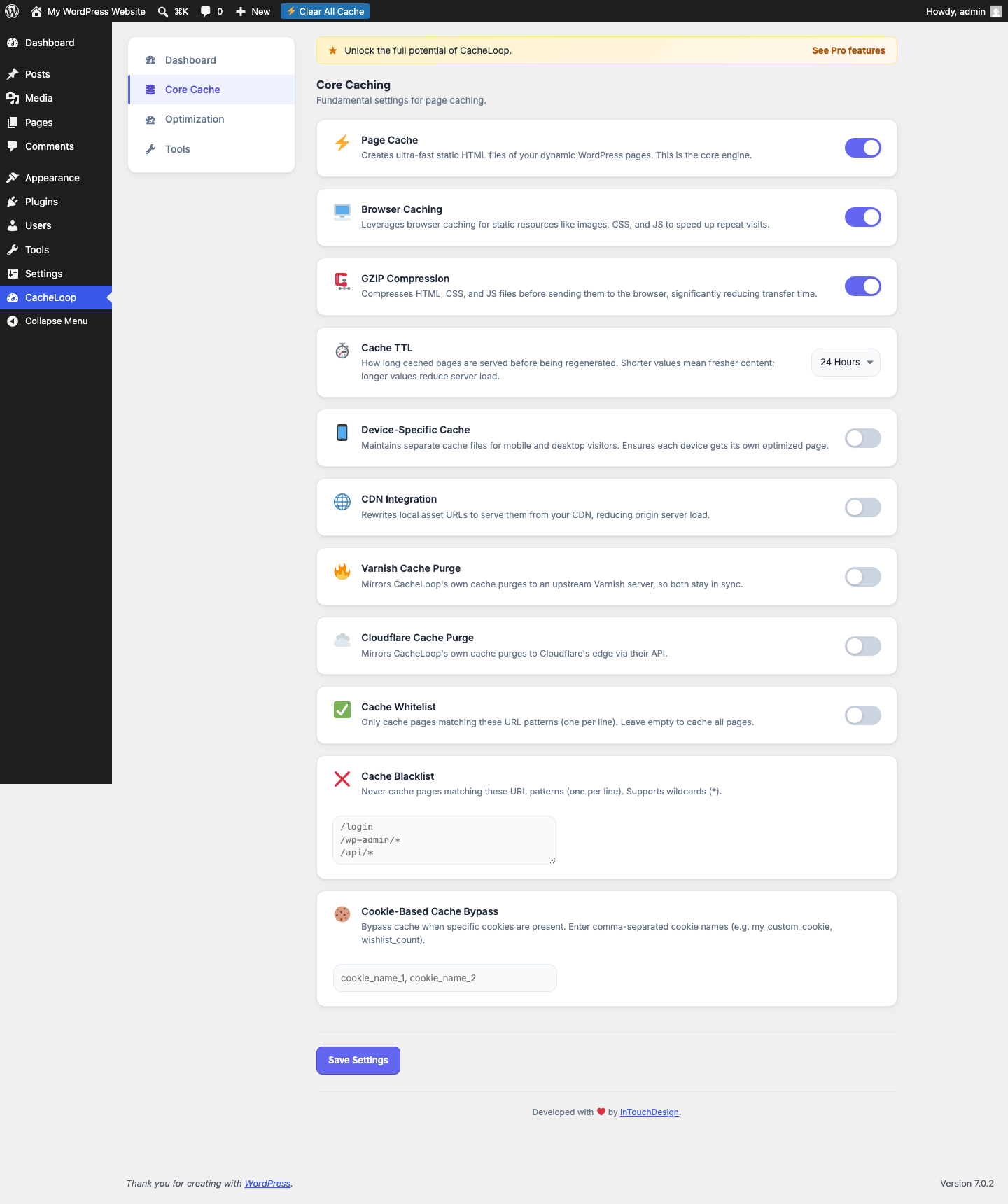
- Page Cache – Saves your pages as fast static HTML files so visitors get them instantly.
- Browser Cache – Tells browsers to remember static assets locally so repeat visits are blazing fast.
- Gzip Compression – Compresses pages before sending them to visitors, reducing data transfer.
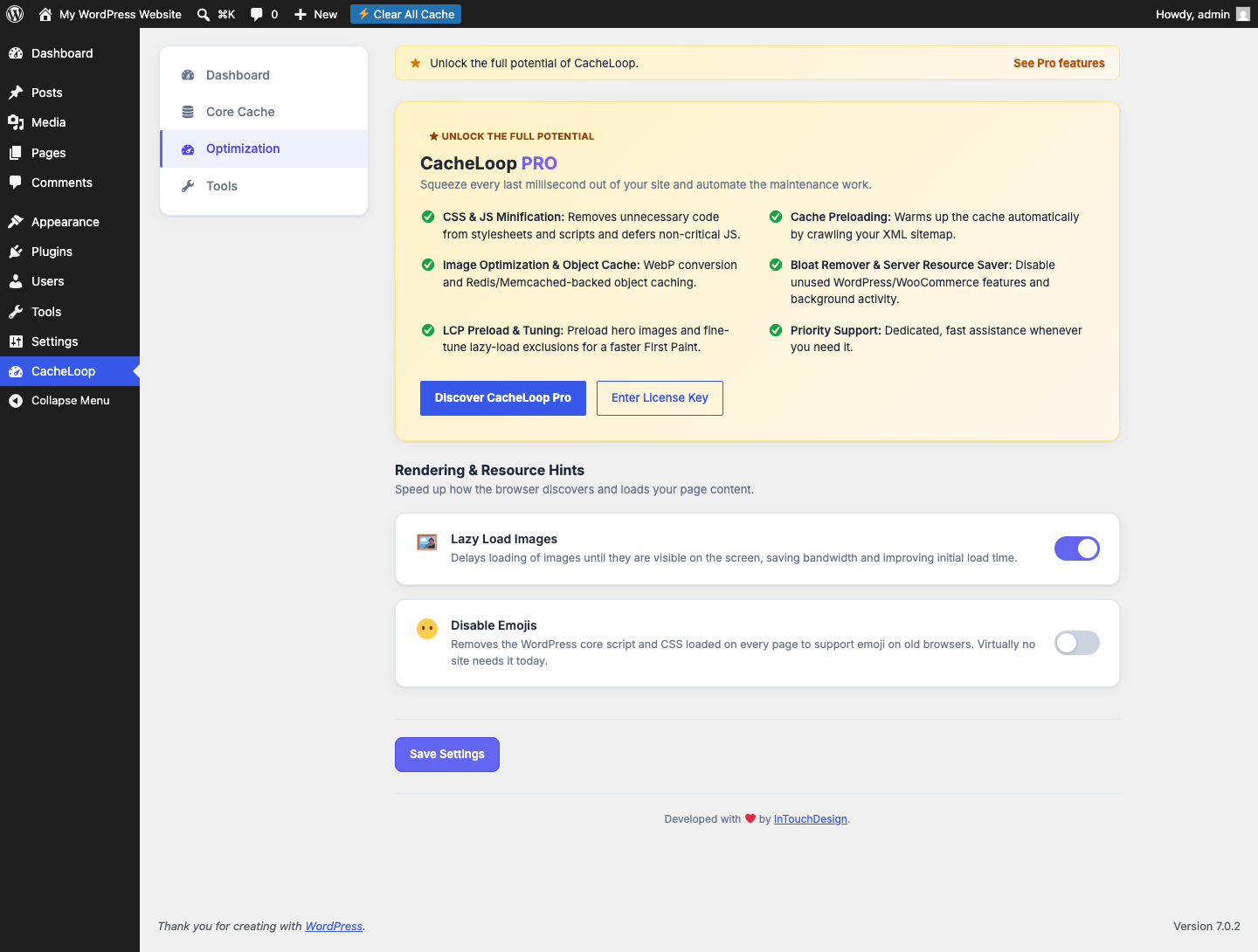
- Image Lazy Loading – Loads images only when they scroll into view, speeding up initial page load.
- Configurable Cache TTL – Choose how long cached pages are served (1 hour to 7 days).
- Device-Specific Cache – Separate cache files for mobile and desktop visitors.
- CDN Integration – Rewrite asset URLs to serve them from your CDN (works with drop-in and PHP fallback).
- Cache Whitelist / Blacklist – Exclude or limit cached URLs with wildcard pattern support.
- Cookie-Based Cache Bypass – Skip cache when specific cookies are present.
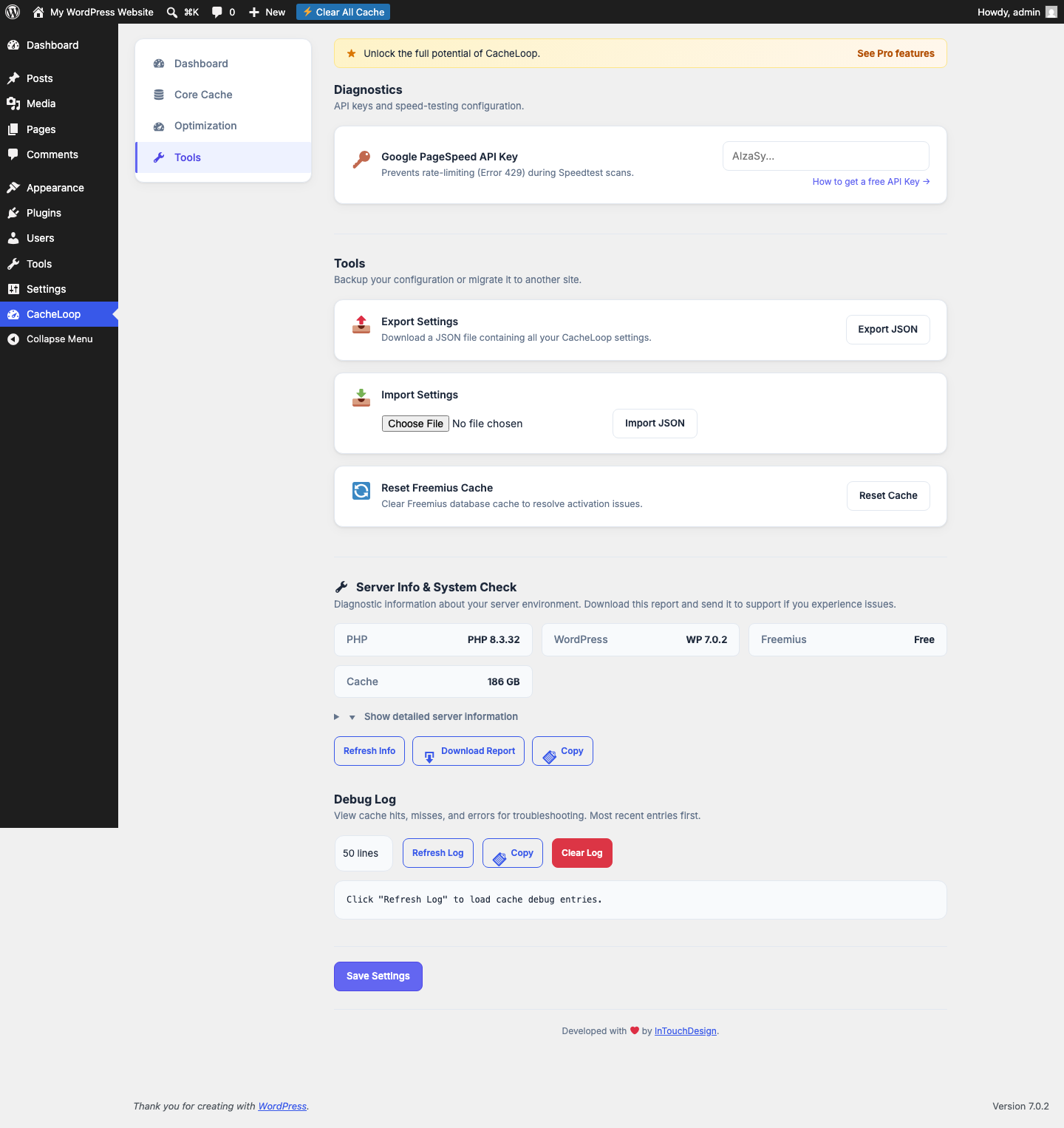
- Debug Log – View cache hits, misses, and bypass reasons directly in admin.
- Admin Toolbar Buttons – “Clear All Cache” and “Purge This Page” from the WordPress admin bar.
- HTTP/2 Server Push – Preload critical CSS assets for faster rendering.
- REST API Cache – Cache common WordPress REST API endpoints (
/wp-json/wp/v2/*). - WP-CLI Support – Manage cache from the command line:
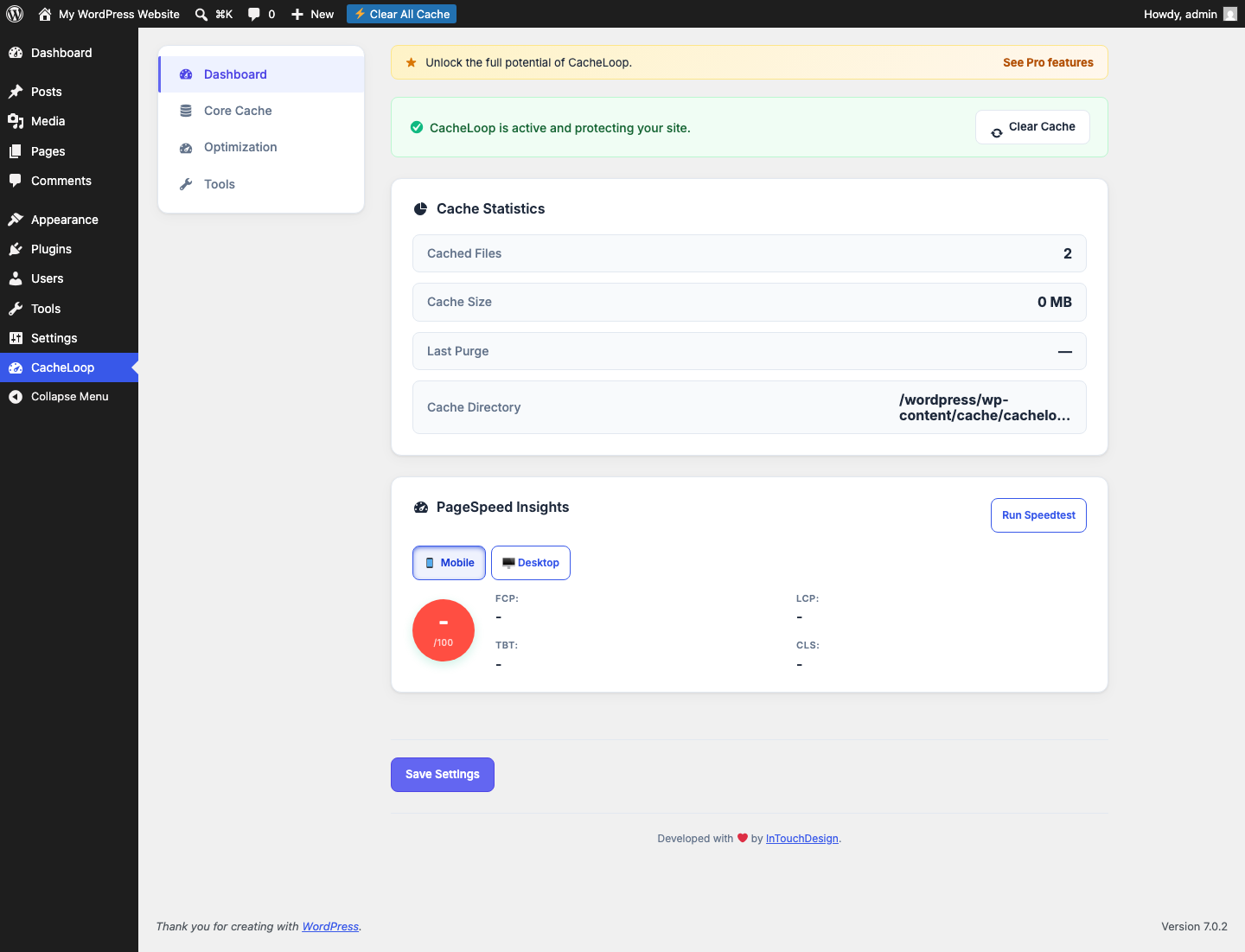
wp cacheloop clear,status,preload,log. - Cache Metrics – See file count, disk usage, and last purge time in the admin dashboard.
CacheLoop Pro
Unlock advanced optimizations:
- CSS & JS Minification – Removes unnecessary code from stylesheets and scripts and defers non-critical JS.
- Database Optimization – Weekly automatic cleanup of old drafts, revisions, and expired transients.
- Cache Preloading – Warms up the cache automatically by crawling your XML sitemap.
- Server Resource Saver – Limits WordPress background activity to reduce unnecessary server load.
- Varnish Cache Purge – Mirrors CacheLoop’s own cache purges to an upstream Varnish server, keeping both layers in sync.
- Cloudflare Cache Purge – Mirrors CacheLoop’s own cache purges to Cloudflare’s edge via their API.
- Unused CSS Removal – Strips CSS rules unused on each page from the combined CSS output.
Learn more about CacheLoop Pro
External services
This plugin provides a built-in speed testing tool to analyze your website’s performance. When you click “Run PageSpeed” in the plugin settings, the plugin connects to the official Google PageSpeed Insights API to generate the performance report.
- Service used: Google PageSpeed Insights API
- Service URL: https://developers.google.com/speed/docs/insights/v5/about
- Privacy Policy: https://policies.google.com/privacy
- Terms of Service: https://policies.google.com/terms
Ecrãs
Instalação
- Upload the
cacheloopfolder to the/wp-content/plugins/directory. - Activate the plugin through the Plugins menu in WordPress.
- That’s it. CacheLoop applies optimal defaults immediately upon activation.
- (Optional) Visit CacheLoop in your admin menu to review or adjust settings.
Perguntas frequentes
-
Does CacheLoop work with WooCommerce?
-
Yes. CacheLoop automatically skips caching for dynamic WooCommerce pages (cart, checkout, my-account) to ensure users always see accurate, up-to-date information.
-
Does CacheLoop work with Nginx?
-
The Browser Cache and Gzip features write to
.htaccessand are Apache/LiteSpeed-only. The Page Cache and Lazy Load features work on all server types. Nginx users should configure browser caching at the server level. -
Will it conflict with my hosting provider’s built-in caching?
-
CacheLoop is designed to be additive. If your host has its own caching layer, the static files CacheLoop generates may simply never be served (the host cache takes priority). In that case you can disable Page Cache in settings and rely on your host’s solution, while still benefiting from CacheLoop’s other optimizations.
-
How do I clear the cache?
-
Click the Clear Cache button at the top of the CacheLoop settings page. The cache is also cleared automatically when you publish or edit a post or page.
-
Is it compatible with Multisite?
-
Single-site only in the current version. Multisite support is planned for a future release.
Avaliações

Contribuidores e programadores
“CacheLoop – Simple Page Cache & Speed Optimization” é software de código aberto. As seguintes pessoas contribuíram para este plugin:
Contribuidores

Traduza o “CacheLoop – Simple Page Cache & Speed Optimization” para o seu idioma.
Interessado no desenvolvimento?
Consulte o código, consulte o repositório SVN, ou subscreva o registo de alterações por RSS.
Registo de alterações
1.0.20
- Added (Pro): “Select all” and “Deselect all” buttons in the Asset Manager CSS and JS lists.
- Fixed: cached pages were often served by the slower PHP fallback (response header
X-CacheLoop-Cache: HIT-FALLBACK) instead of the fast early drop-in. This happened afterwp cacheloop clear, after deactivating and reactivating the plugin with mobile/desktop cache split enabled, and on every page whose address contains special characters (e.g.″or accented letters). The drop-in now always finds the cached pages, and pages with different special characters in the address can no longer share the same cached copy. - Fixed: after an update, CacheLoop could keep behaving as the previous version (no cache refresh after the update) until the settings were saved again.
- Fixed (Pro): “Disable Cart Fragments” and “Disable WooCommerce Assets” no longer break the header mini-cart or “Add to cart” buttons on pages that aren’t shop pages (for example a home page with a product grid). WooCommerce scripts are now removed only from pages that have neither a mini-cart nor add-to-cart buttons.
- Fixed (Pro): Delay JavaScript no longer causes “wp is not defined” errors, never delays cookie-consent banners (Complianz, Cookiebot, iubenda, CookieYes and others), and delayed scripts now run their “page loaded” code, which was previously skipped.
- Fixed (Pro): deferring JavaScript no longer causes “wp is not defined” errors: scripts that WordPress pairs with inline code, and the libraries they depend on, are left in their original order.
- Fixed (Pro): Combine CSS and Local Google Fonts could leave a page without its fonts or styles on hosts that don’t serve files from
wp-content/cache/(and always on Apache/LiteSpeed, where they were blocked). CacheLoop now opens only those asset folders on Apache/LiteSpeed, checks once that the files are reachable, and otherwise keeps the original stylesheets and fonts. Google Fonts written as//fonts.googleapis.com/...are now served locally too. - Fixed: the PageSpeed recommendation for unoptimized images always said “CacheLoop does not compress or convert images”, even on CacheLoop Pro with Image Optimization enabled. It now reflects your actual setup: Pro users are told to enable Image Optimization or run “Optimize All” for existing uploads; only free users are pointed to an external image plugin.
- Fixed (Pro): with Object Cache enabled, a server cron job running a PHP version without the Redis/Memcached extension made WordPress cron process only one scheduled task per run, so background jobs (image optimization, critical CSS, backups) piled up. CacheLoop now tells WordPress when its cache backend is unreachable so cron falls back to the database, and updates refresh an outdated object-cache drop-in automatically.
- Fixed (Pro): if the PHP used by your server’s cron job can’t convert to WebP (a different PHP build than your website), “Optimize All” now pauses and tells you what to change instead of silently skipping images.
- Added (Pro): a status filter (all / errors / skipped / optimized) and an “Export CSV” button on the Optimized Images table, so you can review which images failed and why.
- Fixed (Pro): an image that was already converted could be re-flagged as an “unknown error” (and lose its savings figure) if it was processed a second time, for example by the upload job and “Optimize All” running together. Already-converted images are now recognised as done.
- Fixed: the Server Info panel showed “false” for disk space on hosts that restrict access to the server root; it now reports the space of your site’s own folder.
- Added: the Server Info panel now shows which web server you run (Apache, Nginx, LiteSpeed…) and whether it reads .htaccess.
- Improved: the Browser Caching PageSpeed tip no longer points Apache and LiteSpeed sites at Nginx; it now lists the causes that actually apply to them.
- Improved (Pro): “Optimize All” no longer converts a fixed 3 images per minute. Each background run now works for as long as your server’s PHP time and memory limits safely allow (always at least one image), so fast servers finish a large media library far sooner while slow shared hosts stay within their limits.
- Added (Pro): the “Optimize All” progress now shows a live estimated time remaining, and warns you when progress has stalled because WordPress cron isn’t running (with what to ask your host).
1.0.19
- Fixed: the “Clear All Cache” and “Purge This Page” admin toolbar buttons only appeared in wp-admin — the controller that registers them was only loaded on
is_admin()requests, so the admin bar on the front end never got them (and the “Purge This Page” link’s own handler wasn’t reachable there either). The controller now loads on every request; “Purge This Page” shows automatically on any single post/page, front end included. - Fixed: the “Purge This Page” admin bar button redirected to the homepage instead of back to the page you purged — its link was built against the site’s homepage URL instead of the current page’s permalink.
- Added: an “Exclude this page from the cache” checkbox on the Post/Page edit screen, so an individual page can be kept out of the cache without touching the global Whitelist/Blacklist settings.
- Changed: updated the bundled Freemius SDK from 2.13.2 to 2.13.4.
1.0.18
- Added: a “Download Nginx Config” button in Browser Caching settings, shown automatically when CacheLoop detects your server isn’t Apache/LiteSpeed. Generates a ready-to-use Gzip + static-asset browser-cache snippet, safe to drop straight into your existing Nginx server block, so Nginx-hosted sites no longer have to write these rules by hand.
1.0.17
- Fixed: the advanced-cache.php drop-in was only reinstalled when missing entirely, so sites that updated in-place (WordPress.org auto-update, or any path that doesn’t deactivate/reactivate the plugin) kept running a stale drop-in indefinitely instead of picking up drop-in changes from the new version — with no visible error. The self-heal check now compares file content, not just presence, and reinstalls on any mismatch.
1.0.16
- Fixed: the Premium build’s
is_premiumFreemius flag was hardcoded tofalse(same value as the free WordPress.org build), which hid the “Activate License” button on the Account page — clicking the only remaining button (“Sync License”) just reloaded the page with no effect.is_premiumis now detected at runtime from the presence of Premium-only code, so Premium installs correctly show the license activation flow.
1.0.15
- Fixed: “Exclude First Images from Lazy Load” was hidden behind a Pro check even though the feature itself is implemented in the free code — the setting is now available to all users.
- Fixed: REST API Cache could serve a response generated for a logged-in/privileged request to a later, unauthenticated visitor without re-checking permissions; caching is now restricted to anonymous requests,
wp/v2/settingsandwp/v2/userswere removed from the cacheable list, and the cache key now includes the query string so different request variations of the same route no longer share one cached file. - Fixed: the Object Cache password field was sanitized with
sanitize_text_field(), which can strip valid password characters; it’s now preserved as-is. - Security:
wp-content/cache/cacheloop/(which can contain the Object Cache password inruntime-config.json) is now protected from direct HTTP access via.htaccess. - Changed: internal AJAX/admin-post action names and nonce actions now use the full
cacheloop_prefix instead of the 2-charactercl_prefix, for consistency with WordPress.org’s minimum-prefix-length guidance. - Fixed: deactivating could leave
WP_CACHEenabled with the cache drop-in already removed ifwp-config.phpwasn’t writable, causing “headers already sent” warnings on every page until reactivated; the drop-in is now only removed once disablingWP_CACHEis confirmed.
1.0.14
- Fixed: CDN Integration’s inline CSS
url()rewriting could fatal-error on any cached page (affected both the runtime rewriter and the pre-bootstrap drop-in). - Fixed: the drop-in’s runtime configuration file was being wiped by the cache flush that runs right after every settings save, silently reverting CDN rewriting, custom Cache TTL, Device-Specific Cache, and Cookie-Based Cache Bypass to their defaults.
- Fixed: the admin toolbar’s “Clear All Cache” button pointed at an unregistered action and always produced a blank error page.
- Fixed: Varnish, Cloudflare, and Remove Unused CSS Safelist settings were silently discarded on every save.
- Changed: CDN Domain is now validated as a plain hostname (scheme, path, query strings, and
javascript:/data:values are rejected). - Changed: settings page scripts/styles are now properly enqueued instead of inline; internal class prefix and text domain updated for WordPress.org compliance.
1.0.13
- Fixed: a site could fatal error on every page load (front-end included) on hosts where the filesystem method resolves to non-direct (e.g. FTP) without stored credentials — the plugin’s own filesystem bootstrap wasn’t checking whether
WP_Filesystem()actually connected before using it. - Fixed: version-change cache invalidation and Image Optimization table self-heal were incorrectly skipped whenever the filesystem bootstrap above failed, instead of always running as intended.
- Changed: drop-in self-healing and wp-config.php editing now only run in wp-admin, not on every front-end request.
1.0.12
- Changed: the plugin version now shows at the top of the settings page sidebar, above “Dashboard”.
1.0.11
- Changed: settings cards with extra fields (CDN, Varnish, Cloudflare, Cache Whitelist, Remove Unused CSS) now stay collapsed until their toggle is switched on.
1.0.10
- Fixed: settings cards with extra fields below the main row (CDN, Varnish, Cloudflare, Cache Whitelist/Blacklist, Cookie Bypass, Remove Unused CSS) squeezed that content onto the same row instead of stacking it below.
1.0.9
- Added: Unused CSS Removal (Pro) — strips CSS rules unused on each page from the Minify & Combine output. Conservative by design (keeps anything it can’t verify safely); requires Minify & Combine CSS enabled.
1.0.8
- Added: Cloudflare Cache Purge (Pro) — mirrors CacheLoop’s own purges to Cloudflare’s edge via a scoped API Token, with connection test.
1.0.7
- Added: Varnish Cache Purge (Pro) — mirrors CacheLoop’s own purges to an upstream Varnish server, with connection test and VCL setup snippet.
1.0.6
- Added: Original/Optimized size columns in the Optimized Images table (Pro).
- Added: click-to-preview lightbox for optimized image thumbnails (Pro).
- Added: copy button for Debug Log and Server Info panels.
- Added: estimated time and disk space needed shown before “Optimize All” starts (Pro).
- Added: one-click optimize/revert directly from the Media Library, including bulk action (Pro).
- Added: site-wide progress notice while “Optimize All” runs in the background (Pro).
- Added: hosting panel, active plugins/theme, and load average in Server Info report.
- Fixed: Image Optimization AJAX requests could fail with a raw “unknown action” error when the “Optimize on Upload” toggle was off (Pro).
- Fixed: uninstalling the plugin left generated WebP files behind instead of cleaning them up (Pro).
- Fixed: admin-page AJAX calls firing in a simultaneous burst on load, which some hosts rejected.
1.0.4
- Added: Device-specific cache (mobile/desktop split).
- Added: CDN integration with URL rewriting (drop-in + PHP fallback + inline CSS).
- Added: Cache whitelist/blacklist with wildcard pattern support.
- Added: Cookie-based cache bypass.
- Added: Debug log panel in admin with refresh/clear.
- Added: Admin toolbar buttons (“Clear All Cache”, “Purge This Page”).
- Added: HTTP/2 Server Push for critical CSS.
- Added: REST API cache for common endpoints.
- Added: WP-CLI commands (
wp cacheloop clear,status,preload,log). - Added: Cache metrics dashboard (file count, disk usage, last purge).
- Added: Nginx configuration generator.
- Added: Concurrent write protection via file locking.
- Added: Cache versioning with automatic flush on update.
- Fixed: Double cache serving race condition.
- Fixed: CSS minification breaking strings and url().
- Fixed: Fatal error when premium files missing.
- Fixed: extract() error on runtime config.
1.0.3
- Configurable Cache TTL (1 hour to 7 days).